Tag Archives: books

Me and Harry Potter

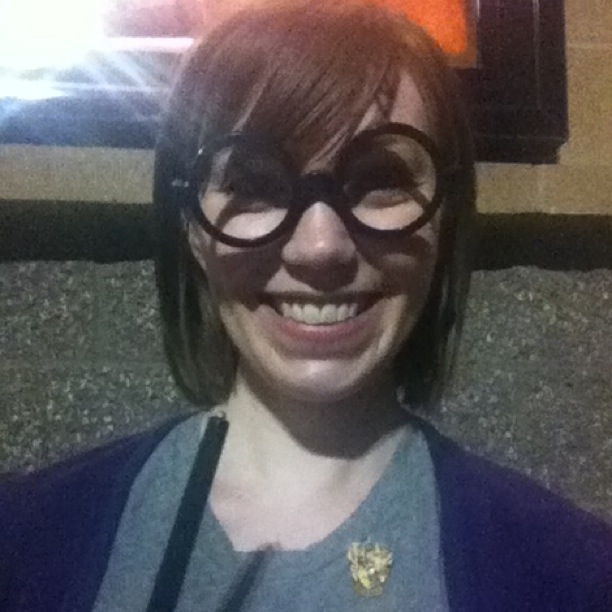
Me at the premier

Harry Potter and I share a birthday. Perhaps because of this I feel that he and I, fictional character though he may be, have a special bond.

After the last book came out, I regretted never attending a midnight release party for one of the books; I suppose I thought I’d be surrounded with noisy children, or (worse) be surrounded with noisy children while I, an adult not accompanying a child, attended a midnight book release party alone. (There is definitely something to be said for having people around who enjoy the same things you do – it’s not something to be taken for granted.)

So, with the release of the final movie installment of the Harry Potter saga, I decided I had to attend the midnight premier. I’m not going to talk about the movie, other than to say that somewhere between five and ten Kleenex were used by me alone, and that – finally – they got it right.

This last weekend, with a little too much time alone on my hands, I spent a lot of time thinking about this ten-year journey. I started reading Harry Potter in college; J. K. Rowling had already written four books before I read the first one. But I was immediately hooked. I reread the first book this last weekend, and I was reminded of all the things that made me love the books in the first place.

First there was this lonely, orphaned little boy, who escaped his unhappy life with his guardians; he was kind and brave and easy to love. There was Hagrid and Ron and the Weasley twins. And then I met Hermione, who was rather like a braver version of my eagerly overachieving, rule-abiding, tightly wound self, and as I think we all delight in characters to which we personally relate, so I did in Hermione. It’s nearly impossible to single out characters from this series, though, without instantly thinking of others you should have included, like the strict but fiercely loyal Professor McGonagall, the patient and kind Dumbledore, and Dobby and Kreacher!

But as much as I love Harry and Ron and Hermione, my favorite character of all just might be Severus Snape. Maybe I’m just a sucker for tales of tortured souls and stories of unrequited love, but to me, he’s the unsung, tragic hero, who loved deeply and lost much; whose sacrifices, because not obvious, would never be celebrated as other characters’ were.

Beyond the characters, it was the minutiae of the wizarding world – the many little details and the care taken in their creation; things like butterbeer, the entire village of Hogsmeade, Mrs. Weasley’s charmed dish-scrubber, the tents (and handbags, for that matter) that were bigger on the inside, Hermione’s Society for the Promotion of Elfish Welfare. All of the thought and feeling behind the action of the story – these are the precise things that you don’t get from the movies and which together conspire to make the true magic of the Harry Potter stories.

So, happy almost-birthday, Harry Potter, and thanks for the many magical late nights when I stayed up reading far later than I should have done.

Book Dedication for June, 2011

As it happened, I had no birthday party for Lord Peter this month as I so sanguinely hoped.  Hopes are high for next June, which gives all of us plenty of time to find suitable monocles and the rest of our costumery.  Instead, just so he knows I haven’t forgotten about him, here is Dorothy Sayers’s dedication of her first book about Lord Peter.

To M. J.

Dear Jim:

This book is your fault.  If it had not been for your brutal insistence, Lord Peter would never have staggered through to the end of this enquiry.  Pray consider that he thanks you with his accumstomed suavity.

Yours ever,

D. L. S.

Dedication from Whose Body?, by Dorothy L. Sayers.  First published 1923 by Harper and Row Publishers, Inc.

The Brontes Went to Woolworths

Cover image from Bloomsbury Publishing Plc

The Brontes Went to Woolworths, a book by Rachel Ferguson, is one of the strangest novels I’ve read in some time. The Carne family – a widow and three daughters – occupy center stage in this novel, and they were great fun – highly imaginative, theatrical, and personable. But I confess that I felt a bit of the slowcoach as far the Carnes were concerned: forever left behind.

The basic premise of the novel is that the Carnes tend to embellish their lives with imagination; sometimes they “adopt” real people and make them into elaborate personalities that figure in the Carnes’ daily lives. What might happen if you actually met in person someone for whom you had already designated space in your life, whom you felt you already knew?

Spending time with the Carnes is a little like spending time with your most fun, most imaginative, and most energetic friend: someone who appreciates nonsense as much (or more, even) than you, whose conversation you adore, and whose flights of fancy may leave you a little in awe. It was like that with the Carne sisters. Admiring their intelligence, their conversation (with its liberal sprinklings of literary references), I liked them instantly. But, inevitably, as the story progressed, I felt a bit like I might in real life with such a friend: I am too conservative or too inhibited, or perhaps my imagination is too tightly tethered to reality to be either a full participant or an equal contributor to any flight of fancy.

The story is as much about the Carnes’ lives as it is about the lives that they touch – their governesses, for instance. In the closing chapters, the governess (the second governess, which I don’t think gives too much away) believes she has caught on to their “games” and makes an attempt to join in that falls flat, greeted as it was with a certain amount of bemusement by the Carnes.

And thus it was that I found myself relating, not to Deirdre, Katrine, or Sheil Carne, but rather the governess, particularly in that final moment. I can recall all too well being that person – carried away by the moment, perhaps, where I said something, thinking it would be well-received, and that painful knowledge afterward that it didn’t fit. The governess’s pacing in her room that night, reliving the awkward moment, did not help dispel the feeling of relating more to her than to them.

Still, I thought the novel was entertaining and lark-like. I read the majority of this book while on vacation this weekend, a vacation in which a great many things went wrong (stories for another night!). The Carnes go on vacation in this book, about which it is said:

Even a holiday that is going to be a successful one should never be preceded by irritating and exhausting details. One should simply walk out of the house into a car, and be driven, coolly, to the station. And when one arrived, a maid would have unpacked.

Indeed. On that point the Carnes and I definitely agree.

Reading matters, period.

stack of books

Image credit: Sanja Gjenero, stock.xchng

I was poking around on The New Yorker last week with my brand-new, indulgent, digital subscription when a recent Book Bench post caught my eye: “Inside Amazon’s Best-Read Cities”, by Macy Halford. Her post is a response to a recent press release from Amazon.com regarding the “Most Well-Read Cities in America” based on per-capita book sales in cities of 100,000 people or more.

I can’t speak to how anyone else will react to Ms. Halford’s thoughts, but I confess to being by turns amused, irritated, and ultimately outraged. However, deep underneath her arguments are no doubt certain valid points about the conclusions Amazon reached:

The purchase of reading material does not in and of itself mean that a city’s population is well-read. Those books might have been purchased as gifts; or, perhaps those residents, like me, have an ever-growing stack of books they feel they should read because the Hipsters and the Bright Minds working at Any Independent Bookstore or places like The New Yorker are reading them and say that you, too, should be reading them, but which in fact end up gathering dust and are moved from one residence to the next with the best of intentions and a growing weight of guilt. Further, one can be well-read without purchasing books by using his or her local public library.

Of Cambridge, Massachusetts, Amazon concludes, “Not only do they like to read, but they like to know the facts,” citing the number of non-fiction titles purchased by residents of these cities. As the press release points out, the city is home to both Harvard University and the Massachusetts Institute of Technology; but no indication is given regarding the percentage of those non-fiction titles which are textbooks, or whether textbooks were excluded and the numbers were based entirely on narrative non-fiction titles.

Other dodgy conclusions include the identification of Boulder, Colorado, as living up “to its reputation as a healthy city” because of the quantity of Cooking, Food, and Wine books purchased by its residents. Were they all health-food cookbooks, diet cookbooks? Without context, I would alternatively conclude this might be an indicator of a Foodie City.

These were just some of my initial reactions to Amazon’s press release, evidence of my deep-seated disdain of the use of statistics to draw conclusions without providing contextual details. But far greater is my irritation with the thoughts shared on the Book Bench blog:

“If you live in New York, Los Angeles, Chicago, Houston, Philadelphia, San Antonio, etc., don’t let this list make you feel bad. Perhaps you have greater access to bookstores than people in other cities…” Amazon is a bookstore – to which everyone in the cities she lists might have access, through an Internet connection. Hasn’t one of the greatest (and sometimes worst) things about the Internet been access to information? Online bookstores free me from having to chance what may or, more often, may not be in stock on the shelves of my local bookstores. It seems to me she’s insinuating that residents of these cities simply wouldn’t do business with Amazon, for reasons undisclosed.

“As for other cities on the list, my interpretive powers fail me: yes, most of them house universities, but does that really explain why Miami, Orlando, and Hotlanta made the cut?” Why shouldn’t these cities have “made the cut”, exactly? I can’t help thinking that perhaps the bottom line here is that New York City does not appear on Amazon’s list.

“Maybe these places, which have warm climates and generally relaxed atmospheres, buy more enjoyable books – a few Sue Graftons to take to the beach, a couple barbecue cookbooks for the summer kitchen, stuff like that.” So they shouldn’t be considered “well-read” cities because, as she conjectures, the residents are buying enjoyable books?

book shopping

Image credit: Herman Brinkman, stock.xchng

I don’t understand where this idea of “good” comes from: “good” books. What makes a book fantastic for me might make it dull-as-tombs for someone else with different reading tastes. In The Guernsey Literary and Potato Peel Pie Society, Mary Ann Shaffer and Annie Barrows wrote, “Perhaps there is some secret sort of homing instinct in books that brings them to their perfect readers. How delightful if that were true.” I believe that every book has its reader, and every reader has his or her book. What I do not believe – and cannot condone – is the denigration of another’s reading tastes that may differ from one’s own. If literacy statistics are to be believed – that as many as 50 percent of American adults are unable to read at an eighth grade level – I’m just happy to see that there is still interest in books, and that people are still reading.

So, read – read what you like, and don’t apologize for it. Just read.

Middlemarch, and Me, and Summer Reading

books at bedsideThere are approximately thirty books in my bedside stack of in-progress and to-be-read books.

I don’t know the exact number.  Creating an actual reckoning of those volumes would probably fill me with so much guilt I would immediately leave the bedroom and turn on the television.

Right now, I am reading:

The Bronte’s Went to Woolworth’s (Rachel Ferguson)

Mrs. Tim of the Regiment (D. E. Stevenson)

Jonathan Strange and Mr. Norrell (Susanna Clarke)

The Hunger Games (Suzanne Collins)

But summer is approaching, and I have summer reading lists on the brain.  I still sometimes prepare these for myself.  They usually include some of the thirty-odd volumes which seem to have a permanent residence in the stack of to-be-read books; and other books, newer books, which have caught the changing pleasure of my infantile attention span for the moment.

I know my planned summer reading will include Marilynne Robinson’s Home; I’ve been saving it to read when I was in the right frame of mind, as well as – and I am somewhat bracing myself already – George Eliot’s Middlemarch.  When George Eliot last appeared on my blog, it was related to an article I had read about George Eliot that made comparisons to Jane Austen and even – to a degree – wrote about these two authors as though they wrote the same type of novel.

Because I don’t know whether I entirely agree with the conclusions I reached in that post, at book group last weekend I had a very brief conversation with someone who is far more well read and thoughtful about these matters – and who certainly has what I would judge to be a far less emotional attachment to Jane Austen – than me.  From that conversation, I have determined – the academic within requires it of me – to let George Eliot have her fair say.

So, maybe one of you will add Middlemarch to your summer reading list, and we can discuss our findings.  It’s currently winging its way to me; in the interim, lest it come up yet again, my dearest sister, I am (it was at the top of the list!) determined to finish The Bronte’s Went to Woolworth’s, though I confess I have yet to find myself on an even keel in that novel.

What are you going to read this summer?