Category Archives: Books, Reviews, and Reading

Whodunit? Confessions in a Reading Journal

I’ll be honest. I love a good mystery. And lately, I’ve been on a huge (and long-lasting) whodunit kick. That’s part of the reason I haven’t written much lately: I find mysteries really hard to write about without giving too much away.
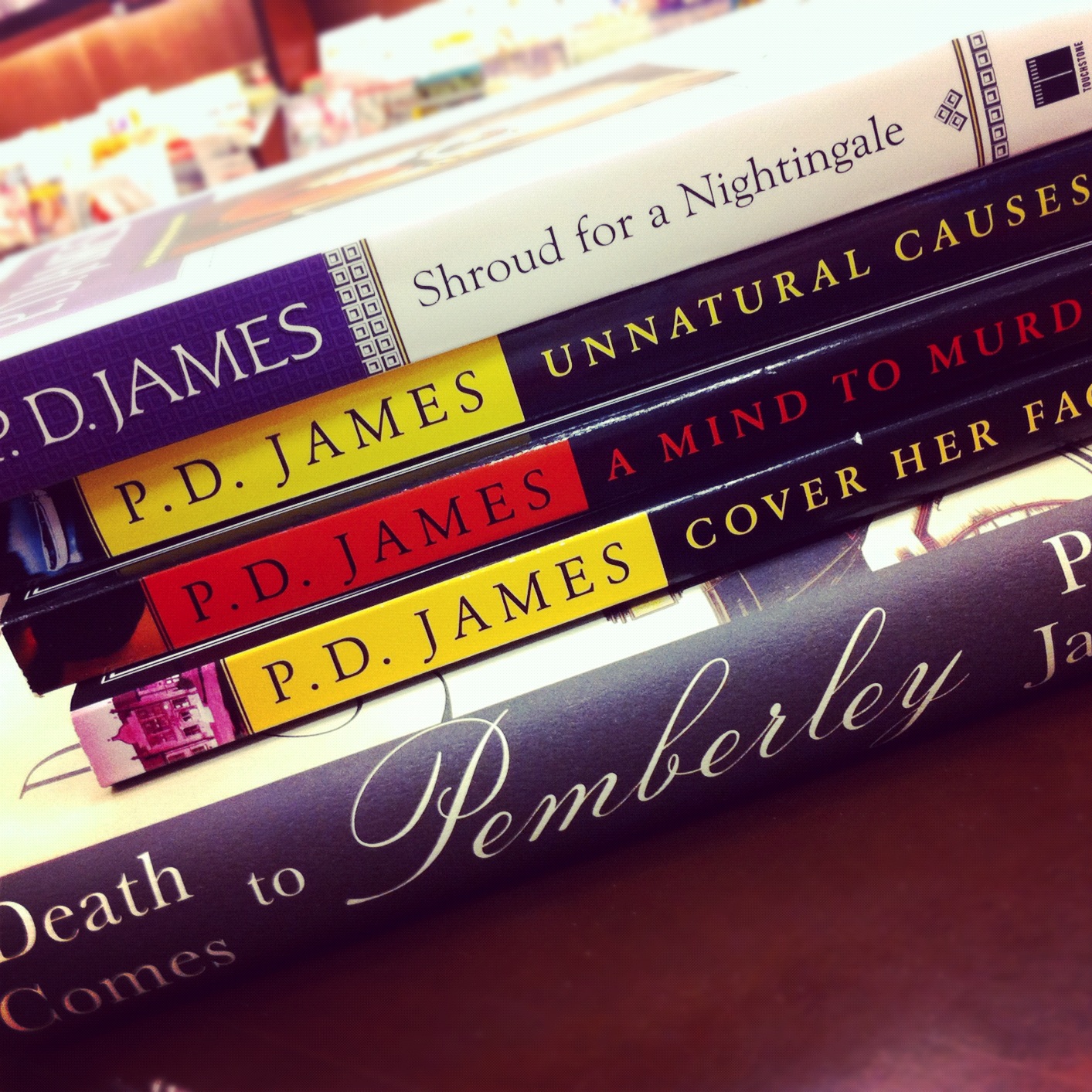
This particular kick all started with Death Comes to Pemberley, P. D. James’s recent release that imagines Elizabeth and Fitzwilliam Darcy’s life at Pemberley, if someone were to complete the pollution of Pemberley’s shades by committing murder therein. I figured that anyone who so expertly captured the tone of Jane Austen, as James does while recapping the whole of Pride and Prejudice in the prologue of Death Comes to Pemberley, was worth reading on her own account:

It was generally agreed by the female residents of Meryton that Mr. and Mrs. Bennet of Longbourn had been fortunate in the disposal in marriage of four of their five daughters…A family of five unmarried daughters is sure of attracting the sympathetic concern of all their neighbours, particularly where other diversions are few, and the situation of the Bennets was especially unfortunate.

In terms of Austen spin-offs, it was the best I’ve yet seen at recapturing Austen’s sardonic tone, and it convinced me to read more. For me, the mystery itself was somewhat forgettable, but, won by her writing from the first, I plunged onward, to Cover Her Face, the first in James’s series about Scotland Yard detective Adam Dalgliesh.

After Cover Her Face, I decided that I quite liked this aloof, intelligent poet-detective, so I read on through A Mind to Murder, Unnatural Causes, and Shroud for a Nightingale. (I’m kind of a stickler for reading books in order.) What I find so compelling about James’s novels is the strong, fine writing and the authentic characterizations. Although most of our time is spent with Dalgliesh, James adeptly moves from one character’s point of view to another’s, and each character’s reactions (as told or perceived) always feel real, and are often sympathetic in their own way. So far, I’ve also found her books to be richly atmospheric, with the place and circumstances of the murder contributing to a unique underlying sense of foreboding. The Black Tower, book number five, is waiting on my Kindle.

Somewhere in the midst of my P. D. James foray, I decided I could no longer put off reading Josephine Tey, who, like Agatha Christie and Dorothy L. Sayers, is considered a queen of the Golden Age of Mystery. I started with Brat Farrar. One of my favorite authors, Mary Stewart, wrote a novel called The Ivy Tree as “fan fiction” for Brat Farrar, so it was high time that I made Tey’s acquaintance. And I loved Brat Farrar. It’s the story of an imposter posing as the returned family heir, a boy who disappeared as a child and was presumed dead.

But Brat Farrar was so much more than that. Josephine Tey had a gift for storytelling, for drawing you along and making characters real and sympathetic. My favorite part of this book – though this could be considered a spoiler – was that Tey never tells us how the murder was done. It’s a singular triumph, because the story still manages to be fully satisfying. I’ll definitely read more of Josephine Tey.

Although I haven’t spoken of my love for Lord Peter Wimsey recently, you may safely assume it abides unabated, and that one weather eye is always open for a suitable costume monocle. And it was because someone told me that Ngaio Marsh’s gentleman detective, Roderick Alleyn, was rather like Lord Peter that I decided to meet him. So somewhere in the middle of my James spree, I read A Man Lay Dead, which was so enjoyable that it was immediately followed by Marsh’s third book, The Nursing Home Murder. (Marsh’s books are out of print, and not yet all available for Kindle, so I was limited to her first and third efforts; although as of this post’s publication date, Amazon has released 2, 4, 5, and 8 in a “collection” – go figure.) And though Lord Peter isn’t presently in any danger of displacement in my affection, I quite liked Roderick Alleyn, and Ngaio Marsh’s writing, such as:

“Sagacious woman, you have stolen my stock bit of thunder.”

Or:

“You can take that inordinately conceited look off your face and compose it into its customary mould of startled incredulity.”

Or even:

It would be tedious to attempt a phonetic reproduction of Mr. Sage’s utterances. Enough to say that they were genteel to a fantastic degree. “Aye thot Aye heard somewon teeking may neem in veen,” may give some idea of his rendering of the above sentence.

Hopefully, you get the (delightful) idea.

So that’s most of what I’ve been reading of late. Have you read any good mysteries lately?

Neverwhere

cover image via goodreads

When I was a young child, I had pretty distinctive “likes” and “dislikes” when it came to reading. I was fond of thinking of myself as an avid reader, but I refused to read (unless required) any books that had boys as main characters (too boring, according to me, then). I also refused to read any books that used overly dialectal dialogue (especially if that dialect was in any way backwoods-y). Also, not being myself a fan of being dirty, I didn’t really like to read stories where the characters were dirty and their dirtiness was a matter of description or discussion. No, I preferred stories starring female protagonists who were perennially clean (or I never heard otherwise) and spoke the Queen’s English.

Happily, my reading horizons have broadened, although to this day, I believe dialect is something quite easily overdone and very easy to get wrong. But I can now read books with male protagonists without getting bored, and while descriptions of filth might still induce a flinch or two, I can usually soldier through them. So it is a bit of a strange coincidence that when I tell you how I loved reading Neil Gaiman’s Neverwhere, for all its descriptions of filth and malodorousness, that the adjective that first comes to mind is “sparkling”.

I remember when I was young being a little surprised, on visiting the coast, that where the land ends and the ocean begins — something that appears so solid and well-defined on paper — shifts and moves around in real life. In my imagination it made for an intriguing between-space. Gaiman’s book reminded me a little of that daydream, because Neverwhere is about the cracks, and the things and people that fall through them.

Neverwhere is the story of Richard Mayhew, a young man living in London, who stops to play the Good Samaritan to a girl bleeding on the sidewalk and finds his life suddenly turned upside down. Suddenly, it is as though he never existed. In Neverwhere, there is a London Above, where the “normal” people live “normal” lives not seeing the people who have fallen through the cracks to London Below. London Below, where Richard finds himself, is a dangerous place filled with strange people who can  understand animals’ speech. (There are also a great many smells.) And in London Below, Richard’s adventures will require him to be very brave indeed.

If the great story were not enough reason to read Neverwhere, Gaiman’s prose sparkles:

“Metaphors failed him, then. He had gone beyond the world of metaphor and simile into the place of things that are, and it was changing him.”

And it is rich with literary allusion:

“There was hysteria in there, certainly, but there was also the exhaustion of someone who had managed, somehow, to believe several dozen impossible things in the last twenty-four hours, without ever getting a proper breakfast.”

To me, Neil Gaiman is a master storyteller, and in Neverwhere he has crafted (with an almost Dickensian facility for nomenclature) a modern fairy tale, full of heroes and villains and people who fall somewhere in between.

Regency Slang is an Acquired Taste

image via Sourcebooks

I am highly suspicious of all works by authors described as “the next best thing to reading Jane Austen” (unless that author is Barbara Pym), so I was a reluctant latecomer to the novels of Georgette Heyer.

My first attempt at reading one of Georgette Heyer’s books was False Colours. I made it about fifty pages in before I gave up; the vapid mother, improbable identical twin plot, and ultimately the extensive use of Regency slang overcame my patience. For me, the language of Heyer will ever be an acquired taste, and I don’t recommend starting with one of her books that really indulges in it until you’ve acquired it. Eventually, you may even embrace it, and find yourself rejoicing at any opportunity to incorporate phrases like “There’s no need to fly up into the boughs!” into your everyday conversation. (So far, I’ve had only one opportunity, but I remain at the ready, should the occasion call.)

A few years after that first attempt, in a readers’ advisory class in library school, one of my classmates recommended The Grand Sophy to me. I pooh-poohed. I thought I knew better. But another classmate urged me very articulately to reconsider, saying that she didn’t know who was responsible for choosing the order or frequency with which Heyer novels are republished, but someone should really take that person in hand. That following summer, when the stress of my sister getting married and moving halfway across the country was rising, I gave The Grand Sophy a try. If ever there was a time for escapist Regency fiction, it was the summer of 2010.

I’ve written elsewhere about The Grand Sophy, Frederica, and Arabella. What I didn’t say there, though, was that I read The Grand Sophy in less than a week while on my sister’s bachelorette trip in San Francisco; I finished it on the flight home, and immediately upon finishing it, still on the plane, downloaded Frederica to my kindle.

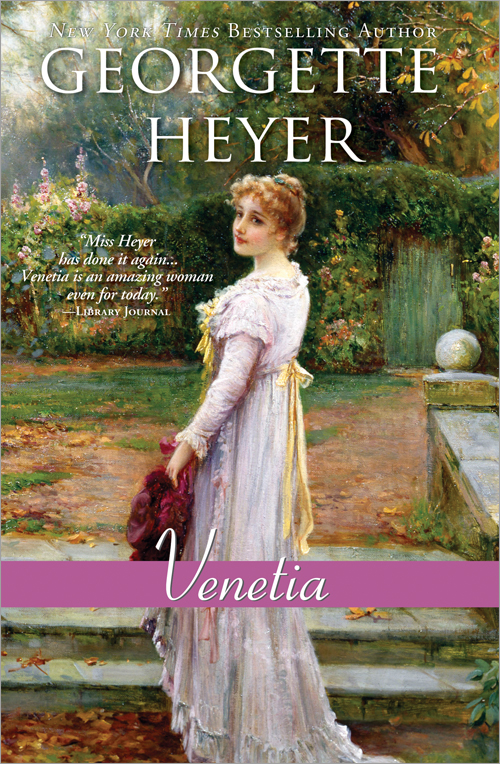
Since reading those three, I’ve gone on to read many more, including: The Nonesuch, Lady of QualityThe Reluctant Widow, Talisman Ring, and, best of all, Venetia. Venetia is far and away my favorite Georgette Heyer novel. Featuring the two most well-read and well-spoken of Heyer’s characters, it’s the sparkliest of the sparkly banter – and happily, unlike some of Heyer’s novels, our hero and heroine get to spend a lot of time together.

I like all of Heyer’s older, “on the shelf” heroines, but Venetia is my favorite probably because I identify the most with her character. She’s a prettier, much more fun and witty version of myself, like how I imagine myself to be on my best days, if all my lines were previously scripted and I had met a worthy opponent. And speaking of worthy opponents: Lord Damerel is a shining example of that ever-so-attractive archetype, the rake seeking redemption (even if he isn’t quite aware of it yet).

But this post isn’t just about Venetia as a novel and how I reread my favorite parts at regular, probably embarrassingly frequent, intervals; it’s also about Venetia, the audiobook, read by Richard Armitage. It’s simply excellent, and worth checking out whether or not you’ve read the novel.

If ever they make a movie version of Venetia, which is a marvelously good idea, they really need to have Richard Armitage play Lord Damerel. I consider Mr. Armitage to be the nonpareil portrayer of conflicted emotions, smoldering glances, and eyes that are “smiling yet fierce” (see North and South); he really is the only choice. And obviously, I would play Venetia. I have no acting training, but I believe, in this case alone, the sheer force of my enthusiasm and familiarity with the story would carry the day.

An Interview With My Favorite Author

image via Farrar Straus and Giroux

There are certain books, certain authors, which I may never be able to write about at length on this blog. Authors whose work I hold too high, books I value too much, to be in any way eloquent about them. Marilynne Robinson is one of these authors.

Once, when I was in Seattle for work, I discovered that Ms. Robinson was visiting and would be doing a reading at the Seattle Public Library on my last evening in town. It didn’t start until 7 or so, and I had a five hour trip to make yet that night, but I stayed; I stood in line for an autograph; I asked, embarrassed though I was, for a photo with her. In the photo, I am smiling hugely, if self-consciously, as she signs my book.

She has just published a new book of essays (in case anyone was wondering what a great gift for me would be), and Linda Wertheimer just interviewed her for NPR’s Weekend Edition. I hope you’ll take a listen.

NPR Weekend Edition interview with Marilynne Robinson

Happy Valentine’s Day, Middlemarch.

One of the many ways I reconciled myself to the idea of not majoring in English in college was my knowledge, even then, that I am perfectly terrible at completing required reading. A significant number of works considered classic I find myself unable to read, including (a moment of truth!) Dickens. How it came about, then, that I forced myself through all those accounting textbooks and read practically every single page of each assigned chapter remains a mystery to me.

I think what’s always hung me up about Dickens, and, frankly, George Eliot, is the sheer quantity of characters and tangential plotlines. I am a person who reads for character in that I like getting to know characters – but I want to relate to them in some way, to champion their causes, and to feel their joys and sorrows; at the very least I want to sympathize with them, even if I can’t fully relate. But particularly with Dickens, and to a certain extent with Eliot, there are so many characters, and sometimes so much time is spent on characters about whom I care less than little, that it makes for very hard going. My attention wanders. I stagger the truly dull points with other material: froth fiction, or magazines, or books where things happen (much more quickly), or books I know I’ll enjoy because I’ve read them before.

image via an anthropologie mailer

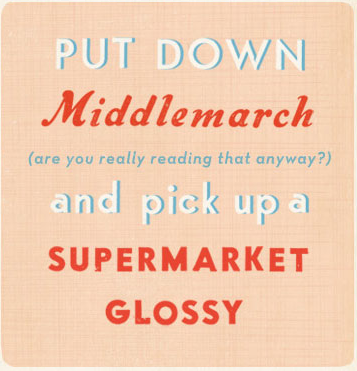
The first Valentine I received this year was from Anthropologie, encouraging me to treat myself for the holiday. It included the graphic off to the left.

I had a brief moment of panic where I thought about privacy on the internet: had Anthropologie gotten access to my GoodReads account, and seen the amount of time Middlemarch has been “in progress”? What information about us do the search engines we prefer really capture? What are the implications for me as a person and society as a whole? Reason returned when I realized, beyond the extreme unlikelihood that they would customize an ad for each customer, that if they had, they probably would have chosen Jonathan Strange & Mr. Norrell, as it’s been “in progress” for (probably much more than) twice as long – yet I’m significantly more certain I’ll enjoy Jonathan Strange & Mr. Norrell, if I could only just devote a lot more time to it.

But perhaps you have had the same question, reading this blog. Is she really reading Middlemarch? Yes. She is. Just very slowly. The speed of my progress is defeated by the depth of character details without any way to easily classify these characters as “good” or “bad”. (This is clearly not what impedes me with Dickens, as good-bad classification there is generally easy; it’s solely the quantity of tangents and characters that waylays me.) It may be a gaping weakness in my character and reading habits that I search for the characters I like best in stories. And where I’m struggling in Middlemarch is that there isn’t anyone I really like, except (so far) the Vicar, Camden Farebrother. But he’s only recently come on the scene, so it’s really too early to say.

Or maybe I just subconsciously wanted to go through an entire year of holidays with Middlemarch.