Workplace Etiquette: The Garbage Bandit

Someone used my garbage bin at work today.

Not my disposable cup. My candy wrappers, though.

I have to confess to feeling slightly violated when I saw someone else’s disposable cup left in my trash.

Let me explain. In my small cubicle, to reach the garbage, you actually have to walk inside and kind of look around a bit. Then you see it, half-hidden away between my paper-shred box and boxes of stuff that haven’t been disturbed in the three and a half years I’ve been with my current employer, left by some previous tenants of my windowless box (and which I am afraid to investigate due to the likely presence of lethal dust bunnies or, worse, spiders or other vermin). Suffice it to say that use of my garbage bin entails more than just a stroll past my cube and a casual flick of the wrist.

Maybe I’m bothered because my employer’s janitorial services do not extend to the emptying of employees’ trash bins. We empty them ourselves. This was quite a surprise to me, coming from the high-stress industry of banking, where the janitorial service emptied our trash regularly. I remember they even once or twice threw out a plastic bottle I had left on my desk planning to reuse. When I started working at my current employer, I may have even had to ask someone why no one was emptying my trash bin. So by using my trash bin at work, instead of one of the communal ones the janitorial staff actually does deal with, or even better, his or her own garbage bin, this Garbage Bandit of mine effectively contrives to avoid having to take out his or her own trash.

Happily, it would appear that nothing else in the (I assure you, very organized) chaos of paper piles and stacked-up sticky notes occupying the majority of my desk surface was disturbed. But still. Maybe I have an introvert’s characteristic horror of too much being discoverable about me through my trash. Maybe other introverts will agree with me, that use of someone else’s trash bin (when there are several communal trash bins within an easy distance of my desk) constitutes a violation of workplace etiquette. Or maybe it isn’t because I’m an introvert that I feel this way, but rather because I’ve watched too much television where going through someone’s trash is a relatively common occurrence. Most likely, I harbor a secret shame about the quantity of candy wrappers that accrue in a typical workweek.

Because it might be cathartic to come clean about my garbage (no pun intended), what you will likely find if you go through my trash:

  • candy wrappers
  • used paper
  • sticky notes full of scribbling
  • lots of napkins
  • occasional receipts
  • empty cups of yogurt
  • candy wrappers that I tried to hide under other paper

You’ll note the absence of disposable cups, unless the Garbage Bandit strikes again.

Whodunit? Confessions in a Reading Journal

I’ll be honest. I love a good mystery. And lately, I’ve been on a huge (and long-lasting) whodunit kick. That’s part of the reason I haven’t written much lately: I find mysteries really hard to write about without giving too much away.

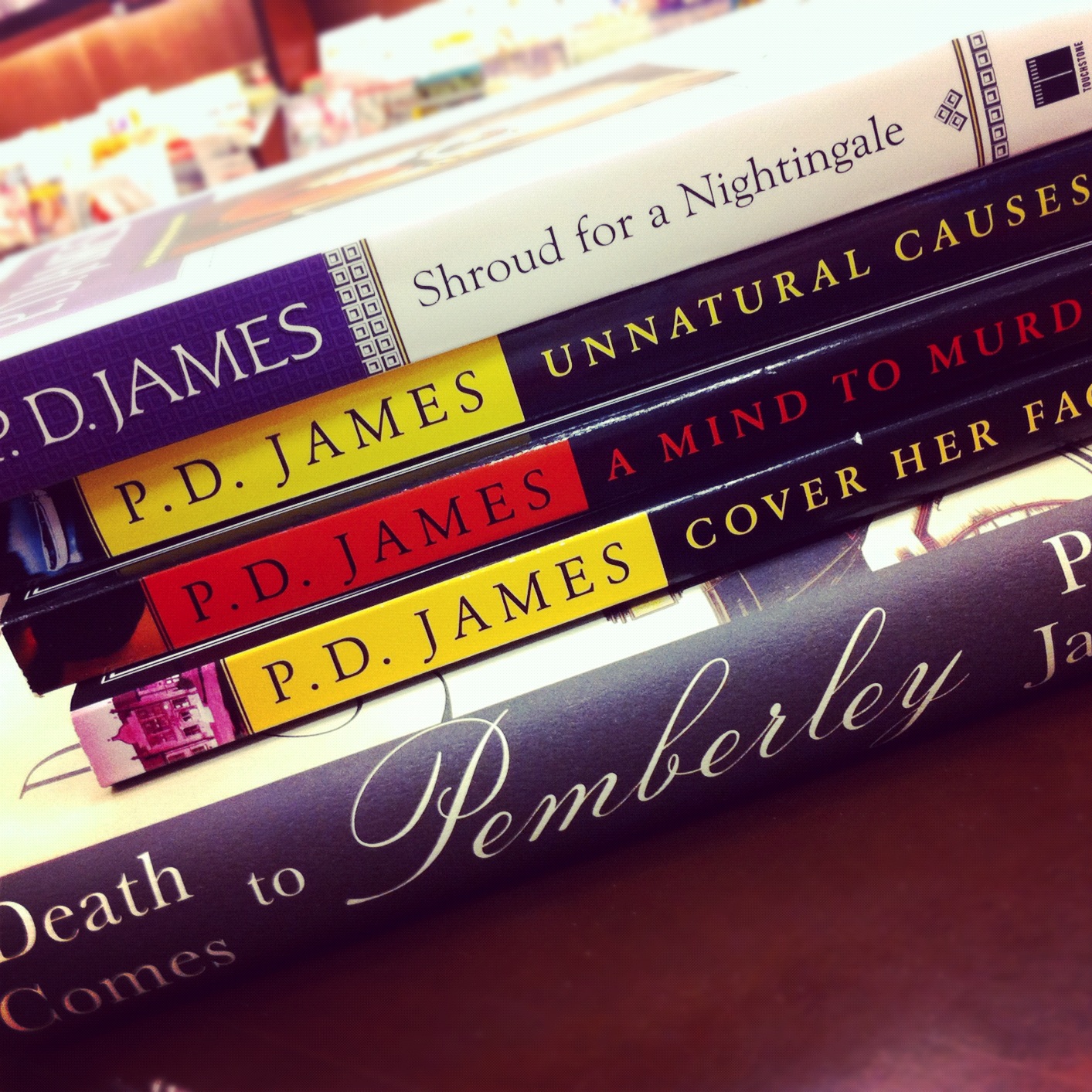
This particular kick all started with Death Comes to Pemberley, P. D. James’s recent release that imagines Elizabeth and Fitzwilliam Darcy’s life at Pemberley, if someone were to complete the pollution of Pemberley’s shades by committing murder therein. I figured that anyone who so expertly captured the tone of Jane Austen, as James does while recapping the whole of Pride and Prejudice in the prologue of Death Comes to Pemberley, was worth reading on her own account:

It was generally agreed by the female residents of Meryton that Mr. and Mrs. Bennet of Longbourn had been fortunate in the disposal in marriage of four of their five daughters…A family of five unmarried daughters is sure of attracting the sympathetic concern of all their neighbours, particularly where other diversions are few, and the situation of the Bennets was especially unfortunate.

In terms of Austen spin-offs, it was the best I’ve yet seen at recapturing Austen’s sardonic tone, and it convinced me to read more. For me, the mystery itself was somewhat forgettable, but, won by her writing from the first, I plunged onward, to Cover Her Face, the first in James’s series about Scotland Yard detective Adam Dalgliesh.

After Cover Her Face, I decided that I quite liked this aloof, intelligent poet-detective, so I read on through A Mind to Murder, Unnatural Causes, and Shroud for a Nightingale. (I’m kind of a stickler for reading books in order.) What I find so compelling about James’s novels is the strong, fine writing and the authentic characterizations. Although most of our time is spent with Dalgliesh, James adeptly moves from one character’s point of view to another’s, and each character’s reactions (as told or perceived) always feel real, and are often sympathetic in their own way. So far, I’ve also found her books to be richly atmospheric, with the place and circumstances of the murder contributing to a unique underlying sense of foreboding. The Black Tower, book number five, is waiting on my Kindle.

Somewhere in the midst of my P. D. James foray, I decided I could no longer put off reading Josephine Tey, who, like Agatha Christie and Dorothy L. Sayers, is considered a queen of the Golden Age of Mystery. I started with Brat Farrar. One of my favorite authors, Mary Stewart, wrote a novel called The Ivy Tree as “fan fiction” for Brat Farrar, so it was high time that I made Tey’s acquaintance. And I loved Brat Farrar. It’s the story of an imposter posing as the returned family heir, a boy who disappeared as a child and was presumed dead.

But Brat Farrar was so much more than that. Josephine Tey had a gift for storytelling, for drawing you along and making characters real and sympathetic. My favorite part of this book – though this could be considered a spoiler – was that Tey never tells us how the murder was done. It’s a singular triumph, because the story still manages to be fully satisfying. I’ll definitely read more of Josephine Tey.

Although I haven’t spoken of my love for Lord Peter Wimsey recently, you may safely assume it abides unabated, and that one weather eye is always open for a suitable costume monocle. And it was because someone told me that Ngaio Marsh’s gentleman detective, Roderick Alleyn, was rather like Lord Peter that I decided to meet him. So somewhere in the middle of my James spree, I read A Man Lay Dead, which was so enjoyable that it was immediately followed by Marsh’s third book, The Nursing Home Murder. (Marsh’s books are out of print, and not yet all available for Kindle, so I was limited to her first and third efforts; although as of this post’s publication date, Amazon has released 2, 4, 5, and 8 in a “collection” – go figure.) And though Lord Peter isn’t presently in any danger of displacement in my affection, I quite liked Roderick Alleyn, and Ngaio Marsh’s writing, such as:

“Sagacious woman, you have stolen my stock bit of thunder.”

Or:

“You can take that inordinately conceited look off your face and compose it into its customary mould of startled incredulity.”

Or even:

It would be tedious to attempt a phonetic reproduction of Mr. Sage’s utterances. Enough to say that they were genteel to a fantastic degree. “Aye thot Aye heard somewon teeking may neem in veen,” may give some idea of his rendering of the above sentence.

Hopefully, you get the (delightful) idea.

So that’s most of what I’ve been reading of late. Have you read any good mysteries lately?

Neverwhere

cover image via goodreads

When I was a young child, I had pretty distinctive “likes” and “dislikes” when it came to reading. I was fond of thinking of myself as an avid reader, but I refused to read (unless required) any books that had boys as main characters (too boring, according to me, then). I also refused to read any books that used overly dialectal dialogue (especially if that dialect was in any way backwoods-y). Also, not being myself a fan of being dirty, I didn’t really like to read stories where the characters were dirty and their dirtiness was a matter of description or discussion. No, I preferred stories starring female protagonists who were perennially clean (or I never heard otherwise) and spoke the Queen’s English.

Happily, my reading horizons have broadened, although to this day, I believe dialect is something quite easily overdone and very easy to get wrong. But I can now read books with male protagonists without getting bored, and while descriptions of filth might still induce a flinch or two, I can usually soldier through them. So it is a bit of a strange coincidence that when I tell you how I loved reading Neil Gaiman’s Neverwhere, for all its descriptions of filth and malodorousness, that the adjective that first comes to mind is “sparkling”.

I remember when I was young being a little surprised, on visiting the coast, that where the land ends and the ocean begins — something that appears so solid and well-defined on paper — shifts and moves around in real life. In my imagination it made for an intriguing between-space. Gaiman’s book reminded me a little of that daydream, because Neverwhere is about the cracks, and the things and people that fall through them.

Neverwhere is the story of Richard Mayhew, a young man living in London, who stops to play the Good Samaritan to a girl bleeding on the sidewalk and finds his life suddenly turned upside down. Suddenly, it is as though he never existed. In Neverwhere, there is a London Above, where the “normal” people live “normal” lives not seeing the people who have fallen through the cracks to London Below. London Below, where Richard finds himself, is a dangerous place filled with strange people who can  understand animals’ speech. (There are also a great many smells.) And in London Below, Richard’s adventures will require him to be very brave indeed.

If the great story were not enough reason to read Neverwhere, Gaiman’s prose sparkles:

“Metaphors failed him, then. He had gone beyond the world of metaphor and simile into the place of things that are, and it was changing him.”

And it is rich with literary allusion:

“There was hysteria in there, certainly, but there was also the exhaustion of someone who had managed, somehow, to believe several dozen impossible things in the last twenty-four hours, without ever getting a proper breakfast.”

To me, Neil Gaiman is a master storyteller, and in Neverwhere he has crafted (with an almost Dickensian facility for nomenclature) a modern fairy tale, full of heroes and villains and people who fall somewhere in between.