In Which I Venture Into Space

You guys! An asteroid almost hit Earth last week! Separately-but-relatedly, a meteorite did explode and hit Earth last week!

And it all makes the perfect introduction to the book I finished reading a few weeks ago…because, that book was set in space!! Maybe that seems like a reach…bear with me! The characters were frequently reminding the reader that one didn’t even need bombs – all that would be necessary to wage war from space on planetary life was dropping rocks. The meteorite last week brought this powerfully to mind.

8855321

Cover image via GoodReads

One of the books I included in my dad’s Christmas booklist was an adventuresome-sounding space tale called Leviathan Wakes, by James S. A. Corey (pseudonym for a writing team composed of Daniel Abraham and Ty Franck, who is George R. R. Martin’s assistant). It was one of those situations where I read the book description and instantly thought of someone, in this case, my dad.

I was speaking to my mother on the phone last month when I heard my dad laughing in the background. “He’s really enjoying his January book,” my mom says. “He’s been laughing a lot.” My curiosity had been piqued by this story, too, and as part of my ongoing efforts to broaden my reading horizons, I decided to read this book “with” my dad.

Although I’m a huge fantasy nerd, I’ve never really been a huge reader of science fiction. I watch science fiction movies happily, but when it comes to going to other worlds entirely inside my own head through a book, I’ve gravitated away from the spaceships and lasers of science fiction and toward the magic wardrobes and wands of fantasy. (I realize that my describing science fiction in terms of spaceships and lasers will be offensive to some readers of science fiction, and I apologize. I agree, it’s a gross generalization.)

Leviathan Wakes is set in the indeterminate future: the human race has colonized Mars and many moons and the Asteroid Belt, but hasn’t ventured any further. Tensions abound between Earth and Mars (the inner planets) and between Earth, Mars, and the “Belters”, represented by the Outer Planets Alliance (or the OPA). Told in the alternating viewpoints of James Holden, the XO of an ice mining ship, and a detective named Miller who works on a space station, the action starts pretty much right away, and doesn’t really stop until the story closes.

This is a story about a search for a missing girl, a search for truth and justice, and about an alien particle; but maybe all you really need to know is that it is very similar in a lot of ways to Joss Whedon’s television show Firefly – and I think can safely say that if you enjoyed Firefly, you should definitely check out Leviathan Wakes. There was not a lot of science, but there was action, mild horror (one reviewer cited the Amazon-identified statistically-improbable-phrase “vomit zombies”), character development, and lots of suspense…cf. this conversation with my dad:

For the record, he didn’t tell me anything. He can be so irritating.

It was super-exciting, y’all, and really a lot of fun imagining a life in a time and place so different from my own. Reading outside your comfort zone can be really rewarding. If you haven’t tried it lately, there’s no time like the present!
Workplace Etiquette: Noise Tolerance

037Noise tolerance is not my strong suit, which may actually be an understatement. I come by it honestly, in my family. Many a night I can recall being almost blissfully asleep, when my sister would suddenly awaken me by hissing my name or hitting me, sometimes with pillows, because the sound of my breathing was annoying her and keeping her from sleeping. (I have allergies.)

I’ve written before about my new cubicle neighbor, the one who’s on a job rotation. Well, ever since he became my neighbor, my limited noise tolerance has been pushed to the brink of breaking. Truth. For evidence I include below an excerpt of an actual instant message conversation I had with my sister:

IM_convo

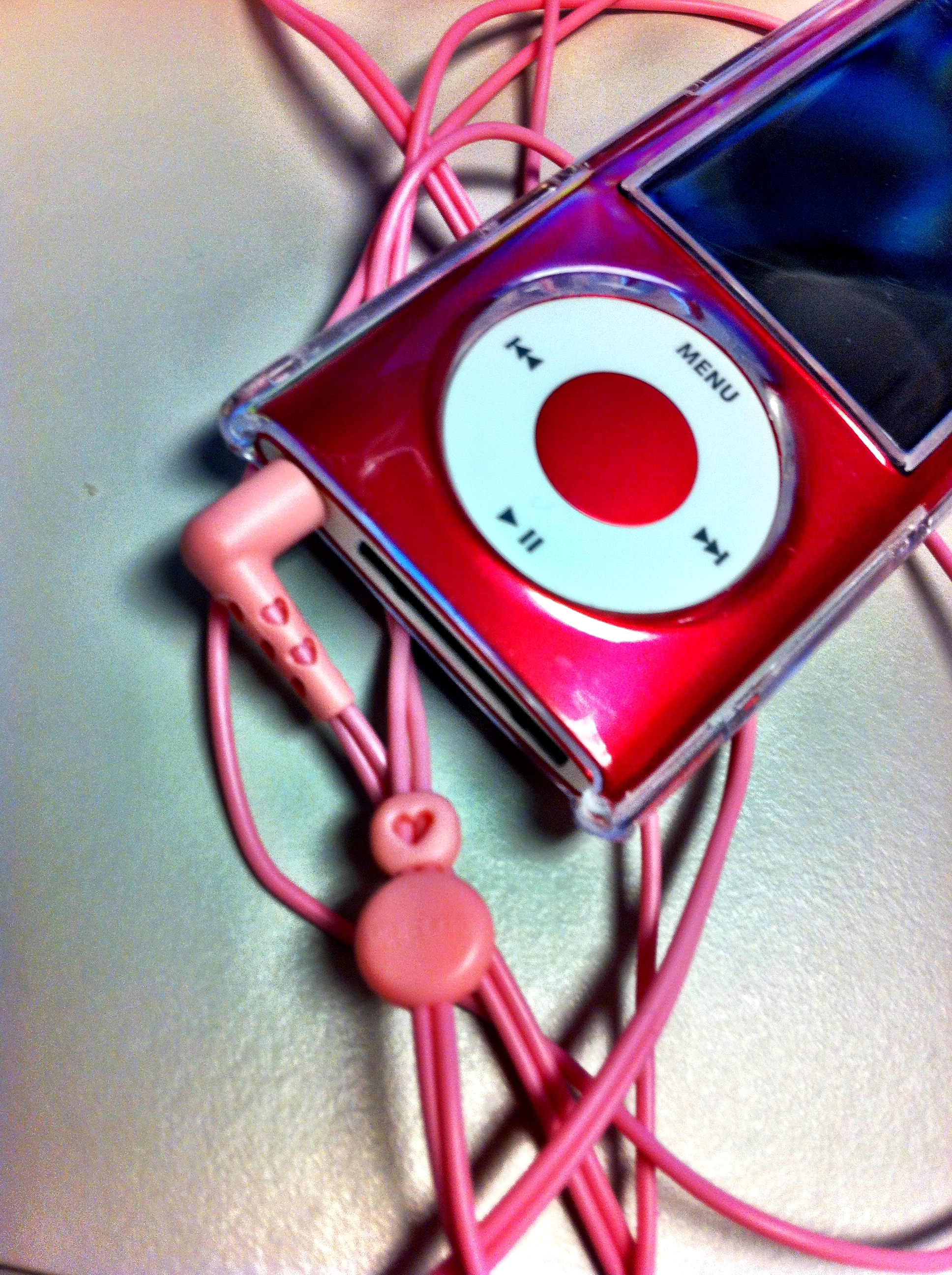
That was in October of last year, around the time of the garbage saga, and suffice it to say, things haven’t gotten better. My workdays since then have been a long, seemingly unending loop of that scriiiiiiitch-scriiiiiitch-scriiiiiiiiitch noise that some mice’s scroll wheels make when used. It’s loud enough to be audible when I have headphones in and a decent, hearing-preserving volume set on my iPod.

But since I was told by multiple other coworkers that I really couldn’t say anything to the new guy without being unforgivably rude, I bore up in the face of this adversity and persevered. There are countless annoying habits I have, I would tell myself; I don’t like it when people use my garbage, for one, and I type with feeling. But there’s just something about that scriiiiiiiiitching noise that makes me want to run screaming through the hallways, you know?

Once I had even plotted with another coworker about secretly replacing the mouse when the new coworker was away from his desk, only to discover that he was using a model that was non-standard for our company and would clearly notice the difference.

And then today happened.

Today during lunch, my boss, who sits several cubicles away from myself and my new coworker, suddenly said, “That’s it!” and walked out to address us. To my newish coworker, he said, “I am getting you a new mouse this weekend.”

Whereupon I kind of lost it and may have said, “I’m so glad someone said something” while choking back tears of relief*.

* This is an exaggeration intended to heighten the comedic impact of this story. But I really did say that.

A Quote I Had to Share

I stumbled across an article on the internet today about a book called How to Talk About Books You Haven’t Read by Pierre Bayard. It was a fascinating article, and it made me want to check out Mr. Bayard’s book at some point. The article used a few quotes that I just had to share:

For we are more than simple shelters for our inner libraries; we are the sum of these accumulated books. Little by little, these books have made us who we are, and they cannot be separated from us without causing us suffering…

The books we love offer a sketch of a whole universe that we secretly inhabit…

Happy reading, everyone.

Me, last summer.

Me, last summer.

The Enchanted April

Image via NYRB Classics

Image via NYRB Classics

There’s nothing like getting to the approximate middle of winter in the Pacific Northwest to make you long for a sight of the sun. And by all accounts, this is a characteristic the Pacific Northwest has in common with London. Nothing sounds better, frankly, than getting away from the gloom for a while and into some warm sunshine.

But in lieu of the Mediterranean vacation currently outside the reach of my budget, and perhaps yours, too, I suggest that you might cast an eye over Elizabeth Von Arnim’s The Enchanted April, and be really glad in the end that you did.

It is just such a fortuitous glance that opens Von Arnim’s tale, when Mrs. Wilkins, taking shelter from the “sooty rain” in her club one afternoon in Hampstead, casts her eye over the newspaper and sees an advertisement for a medieval castle, wisteria, and sunshine, available for rent for the month of April. Even if it’s not gray from where you sit currently, that has to sound like a good idea.

Timid Mrs. Wilkins is so taken with this vision of an April spent in a medieval Italian castle among wisteria and sunshine that she approaches a stranger, one Mrs. Arbuthnot, at her club and broaches the idea of splitting the cost, and the castle: the two of them, getting away from their lives in London, from the gloom and the gray, from their husbands and responsibilities, for a beautiful month. Due to the cost of the trip, Mrs. Wilkins and Mrs. Arbuthnot are joined by a crotchety elderly widow named Mrs. Fisher and the young and very beautiful Lady Caroline Dester.

And so four unhappy women set off to spend a month in something like an earthly paradise, each in her own way looking for something to be found at sunny San Salvatore. A book about four unhappy Englishwomen taking a vacation together may sound unappealing, but let me assure you that it makes for some amount of humor not entirely unlike a Barbara Pym novel.

I don’t suggest this book entirely in lieu of a Mediterranean vacation, because really the book will make you want to see San Salvatore for yourself. This is a book as much about a place as any of the people who go to visit there:

All the radiance of April in Italy lay gathered together at her feet. The sun poured in on her. The sea lay asleep in it, hardly stirring. Across the bay the lovely mountains, exquisitely different in colour, were asleep too in the light; and underneath her window, at the bottom of the flower-starred grass slope from which the wall of the castle rose up, was a great cypress, cutting through the delicate blues and violets and rose-colours of the mountains and the sea like a great black sword.

She stared. Such beauty; and she there to see it. Such beauty; and she alive to feel it.

But mostly this book is about happiness; about how we interact with each other; the things we hang onto, and the things we should let go of. A book about giving, and forgiving. Making it suitable, really, for all times and seasons, not just when I might most need reminding.

A Big Year for Birthdays

It’s a big year for birthdays (birthdays-slash-anniversaries), everyone. This year, my blog turns two (today, in fact — happy birthday, blog!), I will be turning twenty-nine (again), and we mark the 200th anniversary of the publication of Pride and Prejudice.

Image via Jane Austen's Regency World

Image via Jane Austen’s Regency World

It will probably come as a surprise to only a few readers that I subscribe to Jane Austen’s Regency World, the official magazine of the Jane Austen Centre in Bath, England. The January/February issue is almost entirely devoted to Pride and Prejudice, and all sorts of other enormously interesting information, including the identity of the person of who won the auction for Jane Austen’s ring, Kelly Clarkson.

I must confess, I was a little surprised that it was Kelly Clarkson and not a mysterious-and-totally-imaginary secret admirer of mine who converses like Henry Tilney, believes that I could be “the Jane Austen of the Pacific Northwest”, and was saving the ring up as a special surprise present for my 30th (ahem, second 29th!) birthday…but I digress. It turns out a replica of that ring is totally the way to go (major hinting going on, for any mysterious secret admirers) because the United Kingdom declared the ring a national treasure, so Kelly Clarkson can never take it out of the UK.

But enough silliness. The main reason I’m writing tonight is regarding an article in this issue of JARW called “Choose Your Darcy”. That’s right. Amy Patterson, the author of the article, with whom I would very much like to take a turn about the room as well as tea, compares all the different actors who’ve played Mr. Darcy on the silver screen, and, most importantly, comes up with the right answer for who did so best.

Her favorite (and mine)? David Rintoul. Mr. Rintoul plays Mr. Darcy in a so-faithful-to-the-book-you-can-practically-read-along version of Pride and Prejudice that first aired in 1979. I realize I will be alienating many of my friends and probably 90 percent of the internet by not choosing Colin Firth, and my sister by not choosing Matthew MacFadyen, but as far as choosing a Mr. Darcy that most faithfully represents the Mr. Darcy of Jane Austen’s book and of my imagination, I too have to go with David Rintoul.

The 1979 version is not pretty. The costumes seemed quite wretched. But what can I say? Give me a version I can almost read along with and I’m happy, even if Elizabeth is really prettier than Jane. Also, it’s only four hours, instead of a whopping six, largely because it doesn’t insert scenes that Austen never wrote of Darcy emerging wet-shirted from the lake in front of Pemberley, and used only one or two scenes of Elizabeth walking to communicate her fondness of that activity.

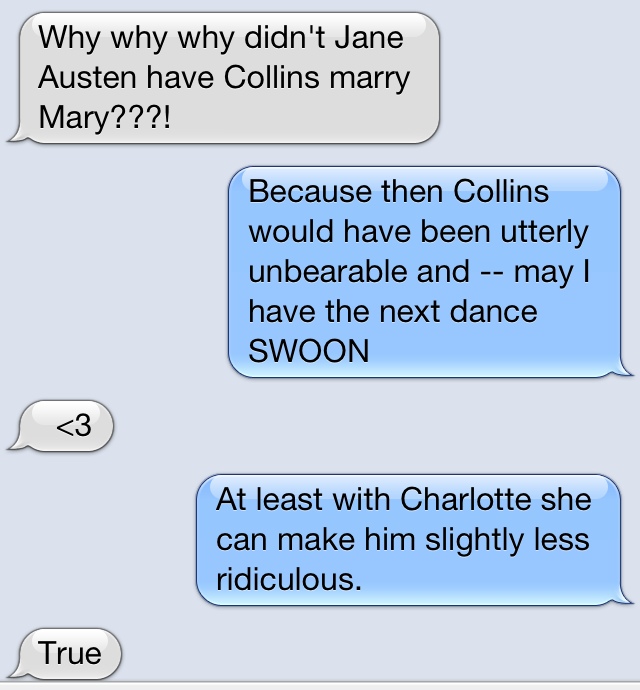
Matthew MacFadyen’s portrayal (circa 2005) is…darned sexy. The best that one can say of that 2005 version is to remark on Matthew MacFadyen’s sexiness, and the fact that it’s one movie long. A faithful representation of the book, it is not (“My pearl for Sundays?” – heaven, give me strength!). Occasionally my sister and I watch the movie together-in-time, if not location, and madly text each other – because this is arguably the most romantic of the versions…and Matthew MacFadyen…and it can be watched in two hours or less, especially if you fast forward liberally, like we sometimes do.

We weren't quite at the same part of the movie here. Nonetheless, enthusiastic.

We weren’t quite at the same part of the movie here. Nonetheless, enthusiastic.

Cut from the image above was my saying something along the lines of “Dang. Matthew MacFadyen.” We aren’t always totally frivolous, either; here you find us actually discussing the story itself:

In between swoons, we discuss authorial decision making.

In between swoons, we discuss authorial decision making.

I just can’t give “best Darcy” to Colin Firth, because, much as I respect Mr. Firth as an actor and like his looks, he just wasn’t the Darcy of the book; he brought too much of the stock “awkward Englishman” to the role. Ms. Patterson says it best in her article in JARW: “David Rintoul, my Mr Darcy, gets closer than any other to capturing the essence of this wonderful, complicated, shy, angry and passionate hero.”

I’ll step down off my soapbox now. Which actor’s portrayal of Mr. Darcy is your favorite?