Tag Archives: books

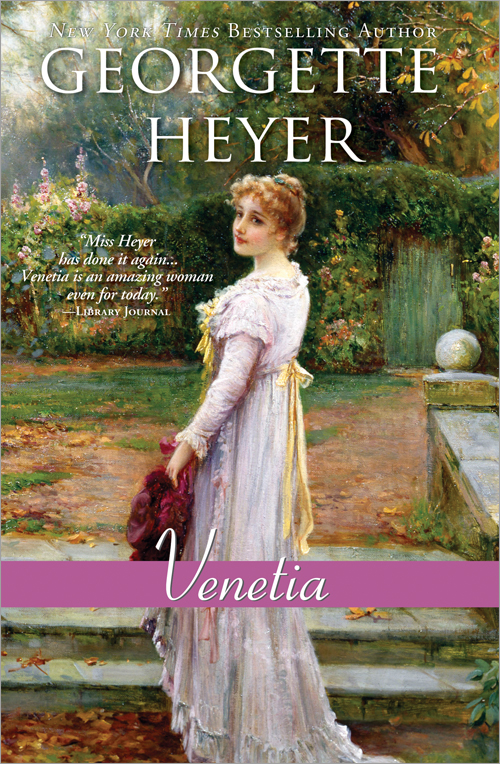
Regency Slang is an Acquired Taste

image via Sourcebooks

I am highly suspicious of all works by authors described as “the next best thing to reading Jane Austen” (unless that author is Barbara Pym), so I was a reluctant latecomer to the novels of Georgette Heyer.

My first attempt at reading one of Georgette Heyer’s books was False Colours. I made it about fifty pages in before I gave up; the vapid mother, improbable identical twin plot, and ultimately the extensive use of Regency slang overcame my patience. For me, the language of Heyer will ever be an acquired taste, and I don’t recommend starting with one of her books that really indulges in it until you’ve acquired it. Eventually, you may even embrace it, and find yourself rejoicing at any opportunity to incorporate phrases like “There’s no need to fly up into the boughs!” into your everyday conversation. (So far, I’ve had only one opportunity, but I remain at the ready, should the occasion call.)

A few years after that first attempt, in a readers’ advisory class in library school, one of my classmates recommended The Grand Sophy to me. I pooh-poohed. I thought I knew better. But another classmate urged me very articulately to reconsider, saying that she didn’t know who was responsible for choosing the order or frequency with which Heyer novels are republished, but someone should really take that person in hand. That following summer, when the stress of my sister getting married and moving halfway across the country was rising, I gave The Grand Sophy a try. If ever there was a time for escapist Regency fiction, it was the summer of 2010.

I’ve written elsewhere about The Grand Sophy, Frederica, and Arabella. What I didn’t say there, though, was that I read The Grand Sophy in less than a week while on my sister’s bachelorette trip in San Francisco; I finished it on the flight home, and immediately upon finishing it, still on the plane, downloaded Frederica to my kindle.

Since reading those three, I’ve gone on to read many more, including: The Nonesuch, Lady of QualityThe Reluctant Widow, Talisman Ring, and, best of all, Venetia. Venetia is far and away my favorite Georgette Heyer novel. Featuring the two most well-read and well-spoken of Heyer’s characters, it’s the sparkliest of the sparkly banter – and happily, unlike some of Heyer’s novels, our hero and heroine get to spend a lot of time together.

I like all of Heyer’s older, “on the shelf” heroines, but Venetia is my favorite probably because I identify the most with her character. She’s a prettier, much more fun and witty version of myself, like how I imagine myself to be on my best days, if all my lines were previously scripted and I had met a worthy opponent. And speaking of worthy opponents: Lord Damerel is a shining example of that ever-so-attractive archetype, the rake seeking redemption (even if he isn’t quite aware of it yet).

But this post isn’t just about Venetia as a novel and how I reread my favorite parts at regular, probably embarrassingly frequent, intervals; it’s also about Venetia, the audiobook, read by Richard Armitage. It’s simply excellent, and worth checking out whether or not you’ve read the novel.

If ever they make a movie version of Venetia, which is a marvelously good idea, they really need to have Richard Armitage play Lord Damerel. I consider Mr. Armitage to be the nonpareil portrayer of conflicted emotions, smoldering glances, and eyes that are “smiling yet fierce” (see North and South); he really is the only choice. And obviously, I would play Venetia. I have no acting training, but I believe, in this case alone, the sheer force of my enthusiasm and familiarity with the story would carry the day.

An Interview With My Favorite Author

image via Farrar Straus and Giroux

There are certain books, certain authors, which I may never be able to write about at length on this blog. Authors whose work I hold too high, books I value too much, to be in any way eloquent about them. Marilynne Robinson is one of these authors.

Once, when I was in Seattle for work, I discovered that Ms. Robinson was visiting and would be doing a reading at the Seattle Public Library on my last evening in town. It didn’t start until 7 or so, and I had a five hour trip to make yet that night, but I stayed; I stood in line for an autograph; I asked, embarrassed though I was, for a photo with her. In the photo, I am smiling hugely, if self-consciously, as she signs my book.

She has just published a new book of essays (in case anyone was wondering what a great gift for me would be), and Linda Wertheimer just interviewed her for NPR’s Weekend Edition. I hope you’ll take a listen.

NPR Weekend Edition interview with Marilynne Robinson

Happy Valentine’s Day, Middlemarch.

One of the many ways I reconciled myself to the idea of not majoring in English in college was my knowledge, even then, that I am perfectly terrible at completing required reading. A significant number of works considered classic I find myself unable to read, including (a moment of truth!) Dickens. How it came about, then, that I forced myself through all those accounting textbooks and read practically every single page of each assigned chapter remains a mystery to me.

I think what’s always hung me up about Dickens, and, frankly, George Eliot, is the sheer quantity of characters and tangential plotlines. I am a person who reads for character in that I like getting to know characters – but I want to relate to them in some way, to champion their causes, and to feel their joys and sorrows; at the very least I want to sympathize with them, even if I can’t fully relate. But particularly with Dickens, and to a certain extent with Eliot, there are so many characters, and sometimes so much time is spent on characters about whom I care less than little, that it makes for very hard going. My attention wanders. I stagger the truly dull points with other material: froth fiction, or magazines, or books where things happen (much more quickly), or books I know I’ll enjoy because I’ve read them before.

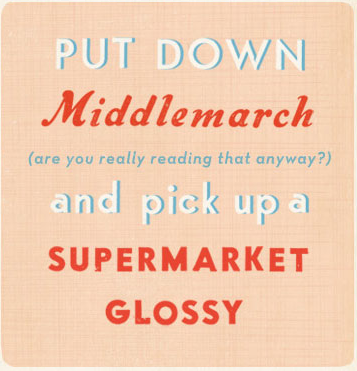
image via an anthropologie mailer

The first Valentine I received this year was from Anthropologie, encouraging me to treat myself for the holiday. It included the graphic off to the left.

I had a brief moment of panic where I thought about privacy on the internet: had Anthropologie gotten access to my GoodReads account, and seen the amount of time Middlemarch has been “in progress”? What information about us do the search engines we prefer really capture? What are the implications for me as a person and society as a whole? Reason returned when I realized, beyond the extreme unlikelihood that they would customize an ad for each customer, that if they had, they probably would have chosen Jonathan Strange & Mr. Norrell, as it’s been “in progress” for (probably much more than) twice as long – yet I’m significantly more certain I’ll enjoy Jonathan Strange & Mr. Norrell, if I could only just devote a lot more time to it.

But perhaps you have had the same question, reading this blog. Is she really reading Middlemarch? Yes. She is. Just very slowly. The speed of my progress is defeated by the depth of character details without any way to easily classify these characters as “good” or “bad”. (This is clearly not what impedes me with Dickens, as good-bad classification there is generally easy; it’s solely the quantity of tangents and characters that waylays me.) It may be a gaping weakness in my character and reading habits that I search for the characters I like best in stories. And where I’m struggling in Middlemarch is that there isn’t anyone I really like, except (so far) the Vicar, Camden Farebrother. But he’s only recently come on the scene, so it’s really too early to say.

Or maybe I just subconsciously wanted to go through an entire year of holidays with Middlemarch.

Off to the circus!

Image via Knopf Doubleday

“It seems a very big decision to me, deciding whether or not to run away and join the circus. Perhaps he did not have enough time to properly consider it.” – Erin Morgenstern

The last time – well, really the only time – I remember going to the circus was some years ago. The Ringling Brothers were passing through, and I tagged along with some friends. I have to confess a certain amount of bewilderment from the experience. Mostly it seemed to me like a lot of action without a cohesive “story” explaining the performance.

Le Cirque des Rêves (The Circus of Dreams) in Erin Morgenstern’s book The Night Circus is a circus unlike any other, shrouded as it is in mystery, and so full of wonders and delights that, visiting, you wonder whether the wonders and delights are real, or merely visions swimming before your eyes. For me, visiting Le Cirque des Rêves (or the Night Circus, as many of its patrons call it, since it is open only at night) was not entirely different from my real-life circus experience: a bit bewildering.

In The Night Circus, two young magicians, Celia and Marco, have been set against one another by their respective teachers in a challenge which they will compete to win. Neither is intended to know their opponent; neither is intended to know that the challenge will only be won by the other’s death. But of course Celia and Marco meet, and quickly discover that each is the other’s opponent. And star-crossed as they are, they fall in love.

The Night Circus itself is the challenge, the “venue” as it is called in the book, but what exactly was expected of Celia and Marco was never quite clear to me, and I’m not certain it was ever clear to them. They contributed to the circus by adding attractions, and in doing so they would try to outdo one another, but the competition quickly faded as Celia and Marco fell in love. Soon their additions to the circus were essentially intended to be pleasing to the other, something they would enjoy: an ice garden, a cloud maze, a pool of remembrance. (It wasn’t clear to me how adding attractions which were intended to be beautiful, creative, and enjoyable to patrons would ever result in the other’s death.)

Aside from the lack of clear direction afforded to Celia and Marco, I found the story a wee bit hard to follow in places, skipping around from one place and character to another, and back and forth through time. Intermittently throughout, the narrative would be interrupted for a description of one of the circus’s many attractions, and while it was enjoyable to visit the circus from so many different perspectives, I never felt like I got to know any single character well enough to really care about them; and for me, the narrative itself was a bit cloudy. I found myself frustrated at times by the lack of clarifying instructions or explanation of why things were happening; the mystery that shrouds the circus itself in the story seems to shroud much of the narrative as well.

But the circus attractions! Those were magic. Morgenstern’s vision of this magic circus is almost cinematically vivid in your mind: its sights and smells and sounds; and if for these alone, The Night Circus is worth a visit of your own.

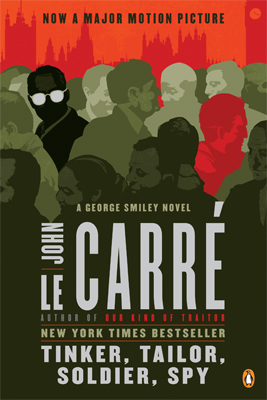
Tinker, Tailor, Soldier, Spy

Cover image from Penguin Group

Before reading Tinker, Tailor, Soldier, Spy, I thought I knew what a spy novel was. I spent my late teens devouring my parents’ Helen MacInnes novels like so many chocolate croissants so often mentioned in those books. I had expectations, going in, of what I would find: innocent civilians, in romantic locations like Prague or Vienna, unwittingly entangled in master webs of international intrigue and suspense, with a car chase (maybe two of these), and perhaps occasional fisticuffs.

John Le Carré more or less blew me away with Tinker, Tailor, and I don’t think he used a single explosion.

What is espionage, anyway? Certainly the covert operations and car chases form some part of it, but I think, far more often than the movies would lead us to believe, espionage is the painstakingly slow, taxing labor of people piecing together truth from snippets here and there.

And piecing together the truth is exactly what George Smiley aims to do, holed away in a hotel room in Sussex Gardens.

I bring up the hotel in Sussex Gardens (chosen for its proximity to Paddington Station!) with such specificity not for the crucial role it plays in the story but because it represents one of those moments I love about reading and traveling; that is, when you stumble upon something in a book that you’ve seen in real life, and you feel that inimitable stroke of delighted recognition. When I visited London in 2009 I stayed in Sussex Place, and crossed Sussex Gardens several times daily.

One of the best parts of the book for me was George Smiley himself: his grumpiness, his need to understand, his hidden romantic soul, even his disappointments were endearing, and you quite simply want him to win at the end. But ultimately, and quite as it should be, the very best part of the book is the ending, which strikes that perfect balance between telling and not telling: no one falls in love, wrongs aren’t suddenly righted, but as the pieces finally fall into place, it is with the sense that events could never have been otherwise.