Off to the circus!

Image via Knopf Doubleday

“It seems a very big decision to me, deciding whether or not to run away and join the circus. Perhaps he did not have enough time to properly consider it.” – Erin Morgenstern

The last time – well, really the only time – I remember going to the circus was some years ago. The Ringling Brothers were passing through, and I tagged along with some friends. I have to confess a certain amount of bewilderment from the experience. Mostly it seemed to me like a lot of action without a cohesive “story” explaining the performance.

Le Cirque des Rêves (The Circus of Dreams) in Erin Morgenstern’s book The Night Circus is a circus unlike any other, shrouded as it is in mystery, and so full of wonders and delights that, visiting, you wonder whether the wonders and delights are real, or merely visions swimming before your eyes. For me, visiting Le Cirque des Rêves (or the Night Circus, as many of its patrons call it, since it is open only at night) was not entirely different from my real-life circus experience: a bit bewildering.

In The Night Circus, two young magicians, Celia and Marco, have been set against one another by their respective teachers in a challenge which they will compete to win. Neither is intended to know their opponent; neither is intended to know that the challenge will only be won by the other’s death. But of course Celia and Marco meet, and quickly discover that each is the other’s opponent. And star-crossed as they are, they fall in love.

The Night Circus itself is the challenge, the “venue” as it is called in the book, but what exactly was expected of Celia and Marco was never quite clear to me, and I’m not certain it was ever clear to them. They contributed to the circus by adding attractions, and in doing so they would try to outdo one another, but the competition quickly faded as Celia and Marco fell in love. Soon their additions to the circus were essentially intended to be pleasing to the other, something they would enjoy: an ice garden, a cloud maze, a pool of remembrance. (It wasn’t clear to me how adding attractions which were intended to be beautiful, creative, and enjoyable to patrons would ever result in the other’s death.)

Aside from the lack of clear direction afforded to Celia and Marco, I found the story a wee bit hard to follow in places, skipping around from one place and character to another, and back and forth through time. Intermittently throughout, the narrative would be interrupted for a description of one of the circus’s many attractions, and while it was enjoyable to visit the circus from so many different perspectives, I never felt like I got to know any single character well enough to really care about them; and for me, the narrative itself was a bit cloudy. I found myself frustrated at times by the lack of clarifying instructions or explanation of why things were happening; the mystery that shrouds the circus itself in the story seems to shroud much of the narrative as well.

But the circus attractions! Those were magic. Morgenstern’s vision of this magic circus is almost cinematically vivid in your mind: its sights and smells and sounds; and if for these alone, The Night Circus is worth a visit of your own.

The Boy Who Sat Next to Me in Math 150 Is All Grown Up

This post's sole piece of visual interest.

It was my very first college class. Math 150. College Algebra.

My older sister, who is amazing and talented and smart, isn’t good at math, and so it happened that Math 150 was not only the first college class I ever took, it was also the first time in my life I was taking a class that she hadn’t already taken. For the first time, I was taking a class where there were no expectations that I would be a carbon copy of my sister.

I myself by no means excel at math; but when I took the college placement test, they put me in College Algebra, and in College Algebra I sat next to a really cute boy. I don’t remember the professor’s name or even any of the math we did in that class (which is kind of odd considering I recall in a nightmarish haze the horrors of statistics and the tears I shed over calculus in college). But I do remember the colors of the leaves on the trees lining the street outside the windows and that the cute boy who sat next to me had some of the bluest eyes I’d ever seen.

I could even tell you his name. It’s been maybe twelve years since that class, but I still remember his name. And the car he drove (a Honda CRX). But in the event that he (like I do, and probably you, too) googles himself occasionally, I won’t risk it.

I bring it up because I am almost one hundred percent positive that my employer just hired him as an information security engineer, and I sat across a conference room from him this afternoon in a meeting as he introduced himself. His eyes are still blue.

I’ve brought up my crazy memory before: my brain tucks away tidbits with tenacity, and sometimes it even surprises me, as this afternoon when the handsome stranger introduced himself as a new employee, and I was temporarily back in Math 150, third row from the front, center aisle.

We only had the one class together (I don’t even think we spoke), and he would shortly be displaced in my late-adolescent crushes by a boy from my speech class who had artfully mussed hair and drove a beat-up brown BMW and played on the basketball team.

With so slight a connection as having had a single class with him some twelve years ago, it’s just all that much more awkward that I remember him, because (let’s face it), any way I bring it up, I sound like a stalker. Honestly I think remembering him has a lot more to do with my unbridled glee at being no longer in high school, and with being in college, which I’d wanted to do since first grade. (And maybe his eyes.)

Part of my brain spent the rest of the afternoon imagining conversational scenarios in which I discovered whether he is, in fact, the boy from Math 150, by broaching various subjects like college, the reliability of Hondas as cars, and where we grew up. None of them ended well, which, in the end, is probably all for the best.

Because if I’m wrong, that might be even more embarrassing than if I’m right.

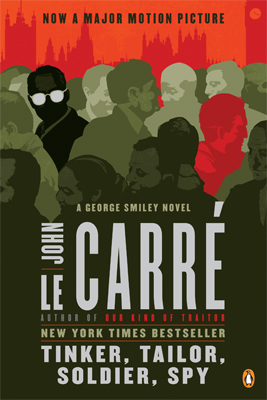
Tinker, Tailor, Soldier, Spy

Cover image from Penguin Group

Before reading Tinker, Tailor, Soldier, Spy, I thought I knew what a spy novel was. I spent my late teens devouring my parents’ Helen MacInnes novels like so many chocolate croissants so often mentioned in those books. I had expectations, going in, of what I would find: innocent civilians, in romantic locations like Prague or Vienna, unwittingly entangled in master webs of international intrigue and suspense, with a car chase (maybe two of these), and perhaps occasional fisticuffs.

John Le Carré more or less blew me away with Tinker, Tailor, and I don’t think he used a single explosion.

What is espionage, anyway? Certainly the covert operations and car chases form some part of it, but I think, far more often than the movies would lead us to believe, espionage is the painstakingly slow, taxing labor of people piecing together truth from snippets here and there.

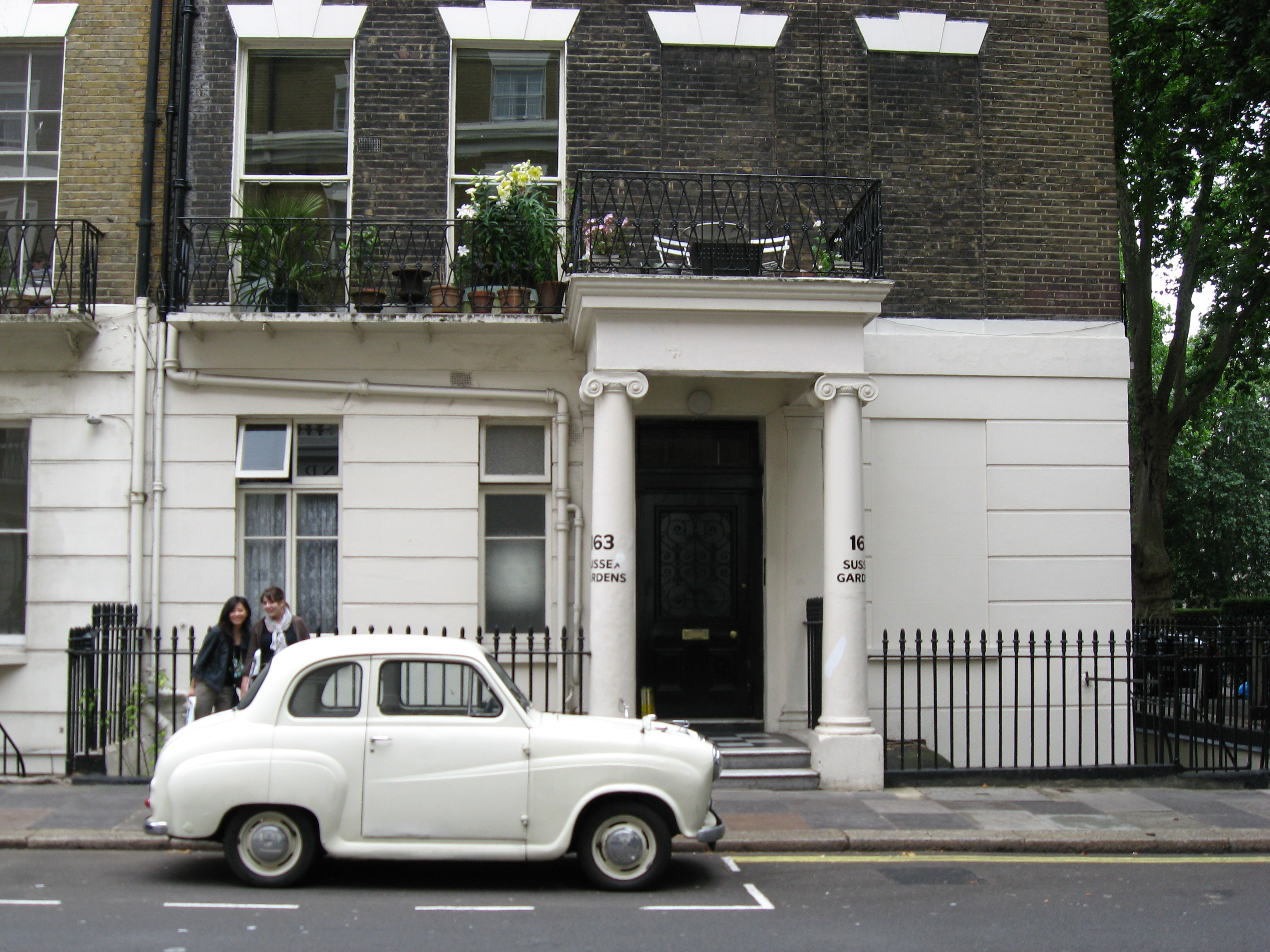
And piecing together the truth is exactly what George Smiley aims to do, holed away in a hotel room in Sussex Gardens.

I bring up the hotel in Sussex Gardens (chosen for its proximity to Paddington Station!) with such specificity not for the crucial role it plays in the story but because it represents one of those moments I love about reading and traveling; that is, when you stumble upon something in a book that you’ve seen in real life, and you feel that inimitable stroke of delighted recognition. When I visited London in 2009 I stayed in Sussex Place, and crossed Sussex Gardens several times daily.

One of the best parts of the book for me was George Smiley himself: his grumpiness, his need to understand, his hidden romantic soul, even his disappointments were endearing, and you quite simply want him to win at the end. But ultimately, and quite as it should be, the very best part of the book is the ending, which strikes that perfect balance between telling and not telling: no one falls in love, wrongs aren’t suddenly righted, but as the pieces finally fall into place, it is with the sense that events could never have been otherwise.