Category Archives: Books, Reviews, and Reading

Off to the circus!

Image via Knopf Doubleday

“It seems a very big decision to me, deciding whether or not to run away and join the circus. Perhaps he did not have enough time to properly consider it.” – Erin Morgenstern

The last time – well, really the only time – I remember going to the circus was some years ago. The Ringling Brothers were passing through, and I tagged along with some friends. I have to confess a certain amount of bewilderment from the experience. Mostly it seemed to me like a lot of action without a cohesive “story” explaining the performance.

Le Cirque des Rêves (The Circus of Dreams) in Erin Morgenstern’s book The Night Circus is a circus unlike any other, shrouded as it is in mystery, and so full of wonders and delights that, visiting, you wonder whether the wonders and delights are real, or merely visions swimming before your eyes. For me, visiting Le Cirque des Rêves (or the Night Circus, as many of its patrons call it, since it is open only at night) was not entirely different from my real-life circus experience: a bit bewildering.

In The Night Circus, two young magicians, Celia and Marco, have been set against one another by their respective teachers in a challenge which they will compete to win. Neither is intended to know their opponent; neither is intended to know that the challenge will only be won by the other’s death. But of course Celia and Marco meet, and quickly discover that each is the other’s opponent. And star-crossed as they are, they fall in love.

The Night Circus itself is the challenge, the “venue” as it is called in the book, but what exactly was expected of Celia and Marco was never quite clear to me, and I’m not certain it was ever clear to them. They contributed to the circus by adding attractions, and in doing so they would try to outdo one another, but the competition quickly faded as Celia and Marco fell in love. Soon their additions to the circus were essentially intended to be pleasing to the other, something they would enjoy: an ice garden, a cloud maze, a pool of remembrance. (It wasn’t clear to me how adding attractions which were intended to be beautiful, creative, and enjoyable to patrons would ever result in the other’s death.)

Aside from the lack of clear direction afforded to Celia and Marco, I found the story a wee bit hard to follow in places, skipping around from one place and character to another, and back and forth through time. Intermittently throughout, the narrative would be interrupted for a description of one of the circus’s many attractions, and while it was enjoyable to visit the circus from so many different perspectives, I never felt like I got to know any single character well enough to really care about them; and for me, the narrative itself was a bit cloudy. I found myself frustrated at times by the lack of clarifying instructions or explanation of why things were happening; the mystery that shrouds the circus itself in the story seems to shroud much of the narrative as well.

But the circus attractions! Those were magic. Morgenstern’s vision of this magic circus is almost cinematically vivid in your mind: its sights and smells and sounds; and if for these alone, The Night Circus is worth a visit of your own.
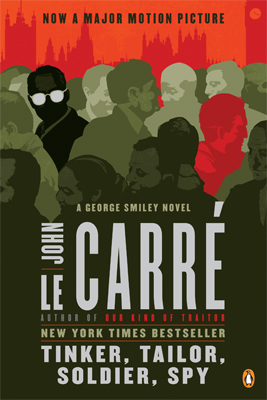

Tinker, Tailor, Soldier, Spy

Cover image from Penguin Group

Before reading Tinker, Tailor, Soldier, Spy, I thought I knew what a spy novel was. I spent my late teens devouring my parents’ Helen MacInnes novels like so many chocolate croissants so often mentioned in those books. I had expectations, going in, of what I would find: innocent civilians, in romantic locations like Prague or Vienna, unwittingly entangled in master webs of international intrigue and suspense, with a car chase (maybe two of these), and perhaps occasional fisticuffs.

John Le Carré more or less blew me away with Tinker, Tailor, and I don’t think he used a single explosion.

What is espionage, anyway? Certainly the covert operations and car chases form some part of it, but I think, far more often than the movies would lead us to believe, espionage is the painstakingly slow, taxing labor of people piecing together truth from snippets here and there.

And piecing together the truth is exactly what George Smiley aims to do, holed away in a hotel room in Sussex Gardens.

I bring up the hotel in Sussex Gardens (chosen for its proximity to Paddington Station!) with such specificity not for the crucial role it plays in the story but because it represents one of those moments I love about reading and traveling; that is, when you stumble upon something in a book that you’ve seen in real life, and you feel that inimitable stroke of delighted recognition. When I visited London in 2009 I stayed in Sussex Place, and crossed Sussex Gardens several times daily.

One of the best parts of the book for me was George Smiley himself: his grumpiness, his need to understand, his hidden romantic soul, even his disappointments were endearing, and you quite simply want him to win at the end. But ultimately, and quite as it should be, the very best part of the book is the ending, which strikes that perfect balance between telling and not telling: no one falls in love, wrongs aren’t suddenly righted, but as the pieces finally fall into place, it is with the sense that events could never have been otherwise.

On Memoirs

This week I read an interesting article in New York Magazine about Joan Didion’s newest memoir, Blue Nights. In it, the author, Boris Kachka, talks to Didion about her success with The Year of Magical Thinking and the new memoir. The article is great, if maybe a little sad, and I hope you’ll take a few minutes to read it. Apparently, I’m not alone in saying so; it was one of the most-read “long reads,” according to the magazine’s facebook page:

From facebook.com

There’s so much fodder for discussion in the article:  Kachka quoting Didion from Slouching Towards Bethlehem, that “writers are always selling somebody out”; Didion’s prescience about the hippy movement and the impact it would have on society as a whole (what, as a result, might be “sacrificed…on the altar of universal love and self-fulfillment”); the honest questions Kachka describes Didion as asking of herself in Blue Nights – about being a parent, and being a good parent.

But I wanted to focus this post on something Kachka says in the article, that “Didion has always maintained that she doesn’t know what she’s thinking until she writes it down.” As a person who has kept a journal for the majority of my life, I can relate. For better or worse, I have always written to understand what’s going on in my head – even just to know what’s going on in my head. (I say “for better or worse”, because you make a record like that, of so many years and so many “places” in your life, and it can be ground you loathe to revisit, yet you find yourself somewhat incapable of destroying it at the same time.)

Later in the article, Kachka says:

…sometimes it’s difficult to tell which of her confessions are genuine and which calculated for literary effect, how much to trust her observations as objective and how much to interrogate them as stylistic quirks. Her clinical brand of revelation can sometimes feel like an evasion – as likely to lead the reader away from hard truths as toward them.

Memoirs as a genre have received a lot of scrutiny lately for a certain lack of truthfulness; we probably all remember the teacup-storms related to Augusten Burroughs’ Running with Scissors. I suppose what I find most interesting about Kachka’s comment is that one might come to the memoir expecting either “to trust her observations” or to be led toward hard truths.

It made me think of something I once read by C. Day-Lewis:

We do not write in order to be understood; we write in order to understand.

The subject matter of Didion’s most recent works, the death of her husband, followed two years later by the death of her adopted daughter, is deeply personal. However, her memoir about the death of her husband, The Year of Magical Thinking, was exceedingly popular. Kachka describes this success pushing Didion into the limelight, casting her in the role of mentor in the minds of some readers, a role with which Didion admits she is uncomfortable.

I’m sure we’ve all had that experience of reading something that speaks directly to our own personal experience or to some part of our souls, and being touched by it in a powerfully meaningful way. But when it comes to the memoir – when it comes to the writer’s need, I guess, to understand by exploring her own thoughts, would it be better, perhaps, if we were to approach it, not as the writer seeking to make herself understood, but as the writer seeking to understand?

What I’ve Been Up To Lately

Such has been the comparative silence on my blog that I can only imagine you all have been wondering what I’ve been reading (and/or doing, if not reading). This post aims to satisfy your no-doubt morbid curiosity.

I’ve been soldiering through Middlemarch. I’ve read 20 percent of the book, according to my Kindle, which feels like an incredible feat. I think I’m going to make it. But most likely not until Christmas, my new deadline.

I find you have to stagger Middlemarch with other things, however, and to that end I’ve started re-reading one of my favorite novels, Gilead, by Marilynne Robinson. Also, after discovering that there is a new movie version of the book Tinker, Tailor, Solider, Spy coming out in December, I decided I need to read the book before that happens.

My parents have an old miniseries/movie version of the story, but it’s one of those movies like The Day of the Jackal that puts me to sleep within fifteen minutes. I don’t know what it is — is it the lack of music? Long, silent, speechless stretches? The book, on the other hand, drew me in from the first line:

“The truth is, if old Major Dover hadn’t dropped dead at Taunton races Jim would never have come to Thursgood’s at all.”

I suppose it’s something about the voice that just grabbed me at the first. This month at book group they are discussing voice as a “doorway” to a novel. My book group has moved all the monthly meetings to Sundays, which don’t work for me at all (highly disappointing), so instead I hope to talk a bit about voice on the blog this month.

In other news, I’ve been traveling, and school (my final fall quarter!) started a week or two ago, and so life has felt a bit as though it was stuck in fast-forward, not entirely unlike this little photo.

A Recent Text-Message Conversation with my Sister

Or, a progress update on Middlemarch. (For the record, spelling and grammar from this text-message conversation have been corrected on both sides.)

Her: With great heaviness of heart, I just purchased Middlemarch.

Me: Woot! she said, with great enthusiasm.

Her: I’m already getting sleepy a paragraph in. That might be an upside…

Me: Haha! Texting me about paragraphic progress will help keep you awake.

Her: Haha! But I want to sleep!

<<the next day>>

Me: I made it through chapter one last night. I pat myself on the back.

Her: Haha! I’m halfway through chapter three!!! I win!!!!!!

Me: For now!!!!!!!!

I’m sure she’s still winning, though. I am through chapter four, bookmark sitting restfully at chapter five, and not feeling inspired to press on. Am I permitted to draw my conclusions after only four chapters?